





A straight flush is one of the strongest and rarest hands in standard poker, beaten only by its own highest form. Most players go through long sessions without ever making one. This guide explains what the hand is, where it ranks, and how to read it at the table.
What Is a Straight Flush in Poker?
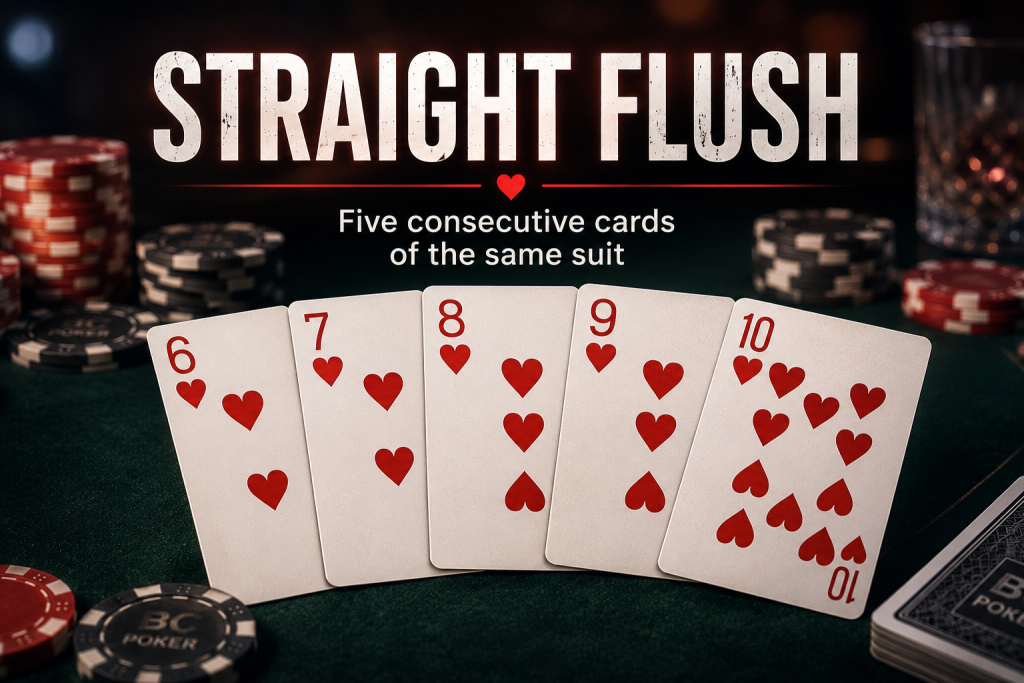
A Straight Flush is any five cards that are both consecutive in rank and all of the same suit. Both conditions must hold at once: the cards run in an unbroken sequence, and every one of them shares a single suit. A clean example is 5♠ 6♠ 7♠ 8♠ 9♠ – five spades in a row. Break the run or mix the suits, and you no longer have this hand.
Straight Flush Examples
Spotting the hand at a glance is a small but genuine part of learning to play great poker, so it helps to line up correct examples against near-misses. Any suit works and the sequence can start at different ranks – 3♥ 4♥ 5♥ 6♥ 7♥ and 8♦ 9♦ 10♦ J♦ Q♦ are both straight flushes. The list below shows how one missing element changes the result:
- Straight – consecutive cards of different suits, such as 6♠ 7♥ 8♣ 9♦ 10♠. There is a sequence, but not one suit.
- Flush – five cards of a single suit with no order, such as 2♣ 6♣ 9♣ J♣ K♣. One suit, but no run.
- Straight Flush – five consecutive cards of one suit, such as 6♣ 7♣ 8♣ 9♣ 10♣. Both conditions met.
The pattern is always the same: drop the shared suit and the hand falls to a straight; drop the sequence and it falls to a flush. Only when both hold together do you have a straight flush.
Where Does a Straight Flush Rank?
A straight flush outranks four of a kind and everything below it, and loses to only one hand – the royal flush. That is because a royal flush is simply the highest straight flush: 10-J-Q-K-A of one suit. Suit itself never changes the strength, so a straight flush in hearts and one in clubs of the same ranks are exactly equal.
How Are Two Straight Flushes Compared?
When two straight flushes meet, the one with the higher top card wins. For example, 9♣ 10♣ J♣ Q♣ K♣ (king-high) beats 7♦ 8♦ 9♦ 10♦ J♦ (jack-high). The ace is flexible – it plays high in 10-J-Q-K-A and low in A-2-3-4-5, the lowest straight flush, often called the « steel wheel. » Suits are not ranked in standard poker, so two straight flushes of identical rank would tie and split the pot.
Straight Flush vs Other Poker Hands
Knowing exactly what this hand beats – and the single hand it does not – is the kind of detail that surfaces in any honest strategy review of a session. The quick comparisons below cover the matchups you are most likely to weigh up:
- Straight Flush vs Four of a Kind – the straight flush wins; it sits one rung higher.
- Straight Flush vs Full House – the straight flush wins comfortably.
- Straight Flush vs Flush – the straight flush wins, adding an ordered run to the shared suit.
- Straight Flush vs Straight – the straight flush wins, adding a single suit to the sequence.
- Straight Flush vs Royal Flush – the straight flush loses; the royal flush is its ace-high version.
In short, only a royal flush can beat a straight flush. Against every other hand, it is the holding you want to be showing down.

How Rare Is a Straight Flush?
The hand is rare by the maths, not just by reputation. Of the 2,598,960 possible five-card hands, only 40 are straight flushes – including the four royal flushes – which works out to about 0.00154%, or roughly one in 65,000. That scarcity is exactly why it ranks so near the very top.
Recognising a Straight Flush in Texas Hold’em
In Texas Hold’em your hand is the best five-card combination from your two hole cards and the five community cards. A straight flush becomes possible when the board already shows suited, connected cards. If the board is 7♥ 8♥ 9♥ and you hold 10♥ J♥, you have a jack-high straight flush; hold 5♥ 6♥ instead and you have the nine-high version. The habit to build is watching for three or more suited cards in sequence on the board, because that is when the hand can appear – for you or for an opponent.
Common Mistakes Players Make
A few errors come up again and again. Players confuse a plain flush with a straight flush, forgetting that the cards must also run in sequence. Others misread the top card and misjudge which of two straight flushes wins. Some assume one suit outranks another, which is never true under standard rules. And many forget that the ace works at both ends of the scale – high in 10-J-Q-K-A, low in A-2-3-4-5 – but cannot wrap around the top, so Q-K-A-2-3 is not a straight flush.
Straight Flush
A straight flush is five consecutive cards of one suit, and it ranks second only to the royal flush, which is its ace-high form. When two straight flushes clash, the higher top card takes the pot, with the ace playing high or low but never wrapping around. Because the hand is so rare and so strong, recognising it instantly – and knowing what it beats – keeps you from misreading a pot you have already won. Hold the two conditions in mind, sequence and suit, and it is easy to spot.